
The government on Saturday announced a host of measures such as setting up of a new Fund of Funds Scheme (FFS) with Rs 10,000 crore corpus; and extension of period of incorporation by five years with a view to promote growth of budding entrepreneurs.
'If a taxpayer opts for the new tax regime once, he can only switch back to the old tax regime once in his lifetime.'

Ahead of the Union Budget, the banking sector, through the Indian Banks' Association (IBA), has made recommendations to the Union finance ministry on direct tax, including removing Section 194N of the Income Tax Act. According to Section 194N, tax deduction at source (TDS) has to be done if a sum or sums withdrawn in cash by a person in a fiscal year exceed Rs 20 lakh if no income-tax return (ITR) has been filed for the three previous assessment years, and Rs 1 crore if ITRs have been filed in all the three previous assessment years.

Ask rediffGURU and PF and MF expert Janak Patel your mutual fund and personal finance-related questions.

The GDP growth is expected to be about 6.3 per cent in the current fiscal year, a tad lower than the government's estimate of 6.4 per cent, owing to several factors such as weak demand, SBI research report said on Wednesday. According to the first advance estimates (FAE) of National Income for 2024-25 released by the National Statistics Office (NSO), released on Tuesday, India's economic growth rate is estimated to slip to a four-year low of 6.4 per cent in 2024-25, because of poor showing by the manufacturing and subdued investments.

The Enforcement Directorate on Monday raided the premises of former Chhattisgarh chief minister and senior Congress leader Bhupesh Baghel as part of a money laundering investigation against his son in the alleged liquor scam case and seized about Rs 30 lakh apart from some documents, official sources said.

The income-tax (I-T) authorities have tightened disclosure norms for charitable trusts. They now have to declare the nature of their activities from October 1 for tax purposes. The Central Board of Direct Taxes (CBDT) has notified changes in reporting rules where the charitable institutions have to mention whether the activities undertaken are charitable, religious, or both to claim tax benefits.

'For me, if I want to buy a house to stay, I don't care about indexation because I don't want to sell that house.' 'The only thing that matters to me as a buyer is that the home price should be within my reach.' 'Any market, when speculators and investors go out, it will benefit the middle class.'
Gross GST collections grew 8.5 per cent to over Rs 1.82 lakh crore in November on account of increased sales spurred by the festive season.

If you lack an emergency fund or it is depleted, use part of your bonus to build or replenish it.
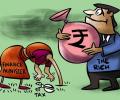
While the tax-to-GDP ratio of 9.88 per cent has been assumed for FY21, the same as last year, when it touched a decadal low, for FY22 a ratio of 10.7 per cent has been assumed, an average of the last five years.

Besides low interest rates, a reduction in active Covid cases and strong high-frequency macro data have lifted the sentiment of both corporate India and the stock markets.

Ask rediffGURU and tax expert Mihir Tanna your income tax-related questions.
Two stock market experts discuss their wishlists for Union Budget 2017 with Rediff.com's Aslam Hunani.

Wants sops to encourage investment and promote entrepreneurship.

'As negotiations continue, the path forward demands not only diplomatic skill, but also vigilance against legal asymmetries embedded in America's trade playbook.'

The new income tax regime for filing returns has been "sweetened" in the Budget 2023-24 and it will be beneficial for maximum number of taxpayers as they can enjoy a "reduced" tax rate, CBDT chairman Nitin Gupta said. Speaking to PTI during a post-Budget interview, Gupta said the intent of the government while announcing the new slabs and rates under the new tax regime is to gradually "do away with deductions and exemptions" so that the "long-standing demand of reduction of taxes for individual taxpayers and entities can be met." Finance Minister Nirmala Sitharaman, while presenting the Budget 2023-24 in the Parliament on Wednesday, said the government has made the new income tax regime more attractive for taxpayers and has thus brought about 'substantial changes' in its structure for the benefit of the middle class.

Benchmark BSE Sensex declined for the fourth day in a row on Wednesday due to selling in financial and banking shares and the government's move to hike securities transaction tax and short term capital gains tax. The 30-share BSE Sensex declined 280.16 points or 0.35 per cent to settle at 80,148.88 with 19 of its components closing lower and 11 with gains. During the day, it tumbled 678.53 points or 0.84 per cent to 79,750.51.

Tax devolution shares, which threaten to create a north-south divide among states, may have more to do with per capita income, and not so much with population.

Mumbai, which adds 37 per cent to the total direct tax mop-up, has reported tax collection of Rs 4.93 trillion so far, against the full-year target of Rs 5.35 trillion.

'It is requested that listed equity shares or units of equity-oriented fund schemes be exempted from capital gains tax (LTCG) if equity shares or mutual funds units are held for at least three years.'

The monthly Rs 2500 payment for poor women is expected to cost Rs 11,000 crore while the pension scheme of Rs 2000 for every senior citizen will cost around Rs 4100 crore. The Yamuna clean up will cost over Rs 10,000 crore while a similar amount is required to upgrade Delhi's hospitals. Ultimately, the new BJP government will have no choice but to ask the centre for financial support, notes Rashme Sehgal.

Mechanism for non-resident service providers made stricter.

DOGE Leader Elon Musk said, "My guess is that a lot of that money ended up in the pockets Hamas, not actually condoms.

Investors should view the increase in the LTCG tax rate in conjunction with the increase in capital gains exemption from Rs 1 lakh to Rs 1.25 lakh, which will provide some relief.

The best solution would be the one followed in 2018 -- allow cost indexation until March 31, 2024 -- but exit at any time. The second-best alternative would be to allow time until March 31, 2025 for investors to exit their investments under the old indexation regime, points out Harsh Roongta.

The government on Tuesday proposed reducing the long-term capital gains tax on immovable properties to 12.5 per cent from 20 per cent, but removed the indexation benefits to adjust for inflation, a move experts termed as "negative" for sellers.

The proposals before the ministry is to hike the tax exemption limit from the existing Rs 250,000 per annum to at least Rs 300,000 if not 500,000.

Stock market investors are expecting a balanced Budget with a focus on job creation, increased spending on infrastructure, reigning in the deficit, and bringing the economy back on track, experts said on Wednesday. Stock markets have been subdued in the run-up to the Union Budget with BSE's benchmark Sensex is almost flat so far this month. Even the corporate earning season failed to excite the markets, while some indices like IT and bankex have seen some positive movements.

'That is the one headline the world is reading about India this week, and it is a potentially damaging story...' 'I don't think a panic mentality has set in, but this story is one that investors and market watchers are absolutely seized with.'

Dear Finance Minister, We don't expect magic, just a little understanding and some tax relief that feels like a real reward, not a bare minimum. A little extra fuel in our wallets could go a long way, pleads Vatsal Ramaiya

'Arbitrage funds make the most sense for those in the 30 per cent tax bracket, are viable for those in the 20 per cent bracket, but less so for those in the 10 per cent bracket.'

High-value insurance policies experienced muted growth in the first six months of the current financial year after the Centre decided to tax such products in this year's Budget. Simultaneously, there has been a marked improvement in the growth of policies with premiums of 'less than Rs 5 lakh', mainly originating from smaller cities. During this year's Budget, Finance Minister Nirmala Sitharaman proposed that insurance policies (excluding unit linked insurance plans or ULIPs) with an aggregate premium exceeding Rs 5 lakh, and the maturity amount, would not be exempt from tax.

The Centre's fiscal deficit at the end of the first five months of the current fiscal touched 27 per cent of the full-year target, government data showed on Monday. In absolute terms, the fiscal deficit -- the gap between expenditure and revenue -- was at Rs 4,35,176 crore as of August-end, according to data released by the Controller General of Accounts (CGA). The deficit stood at 36 per cent of the Budget Estimates (BE) in the corresponding period of 2023-24.

18% cent GST on iPhones continues to weigh heavily on the final cost to Indian consumers, limiting the impact of price cuts.

Tax experts say one of the most dispute-prone proposals is making "fraudulent availing" of input tax credit (ITC), without an invoice or bill, a cognizable and non-bailable offence.

Leading passenger vehicle maker Maruti Suzuki on Saturday reported marginal growth while Hyundai and Tata Motors posted a decline in their sales in February as a slowdown in the market continued with demand remaining muted. On the other hand, Mahindra & Mahindra and Toyota Kirloskar Motor posted double-digit growth riding on their SUV and MPV models.

Stopping SIPs during a downturn undermines the benefit of rupee-cost averaging.

States are on track of fiscal consolidation with their total borrowings reaching Rs 5 trillion till October, which is 60 per cent of the projected borrowings of Rs 8.38 trillion till December 2024, according to data from official sources. Government officials said the lower-than-projected borrowings by states were a sign of prudent fiscal management by them. States announce their borrowing plans every quarter.
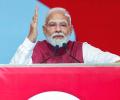
Prime Minister Narendra Modi asserted that his "vocal for local" campaign is bearing fruit as Indian products are going global and making their presence felt across the world. He said that India was becoming the land of infinite innovations, finding affordable solutions and offering them to the world. The prime minister also highlighted the country's rising defense products, electronics, automobile sector, and the success of superfoods, Ayush products, and yoga. He said India should be presented to the world as it is, without any bias. Modi said that the country was now emerging as a manufacturing hub and a "factory of the world." He added that India was creating solutions that were affordable, accessible, and adaptable, and offering them to the world without gatekeeping.
 © 2026 Rediff.com - Advertise with us - Disclaimer - Privacy Policy - Sitemap - Feedback - About us - Terms of use - Grievances